

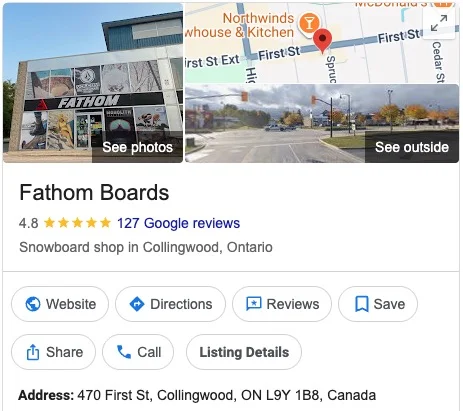
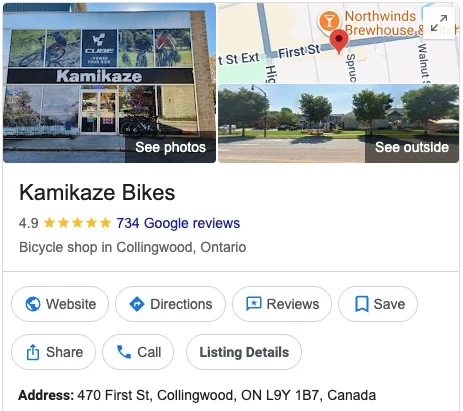
Short answer: Yes, Google allows two businesses to share an address. In fact, it's reasonably common in North America. E.g., a Starbucks inside a grocery store, a McDonald's inside a Walmart, etc. Near me, there is a single building that contains a bike shop and a separate snowboarding store! The common thread: the two businesses are different and independent.
The Guidelines state, "Do not create more than one page for each location of your business." Google wants to avoid situations where a single business offers two services and tries to create a profile for each service.
Here's an easy way to think about it: If you have a business at some location, and you sublease part of your space to someone else to run a business at the same address, once you're both up and running, the two businesses will:
Q: Do the two businesses have to be owned by different people?
A: No. General guidance: If you want your business to offer a second service, and that service makes sense as a page on your website, you should probably only have one profile. If you want to offer a very different service that is best provided by a new company and is best described on a totally separate website, you might be eligible for a second profile.
Q: Do the two businesses need to have their own entrances?
A: No. There is a common belief that they need their own door, but this is not true. It probably comes from the Guidelines, which mention the following about departments "Typically such departments have a separate customer entrance". However, 1.) this is not a firm requirement, and, more importantly, 2.) it applies to departments of the same business, not to two businesses at one address. (I've worked on several cases where one of the two businesses at a single address was either suspended or needed to be verified, and, in all cases, the two businesses shared a single door. No problem.)
Q: Do you have to add a unique suite number to each address?
A: No.
Q: Can you create two SABs at the same location?
A: Yes. The same model applies. You can just ignore the things that don't apply. (E.g. storefront signage isn't a factor)
The Guidelines state, "Do not create more than one page for each location of your business." Google wants to avoid situations where a single business offers two services and tries to create a profile for each service.
Here's an easy way to think about it: If you have a business at some location, and you sublease part of your space to someone else to run a business at the same address, once you're both up and running, the two businesses will:
- have their own unique names,
- and unique signage on the outside of the building,
- their own phone numbers, and
- their own websites.
- different categories (because you wouldn't sublease your space to a competitor!), and
- their own business registration and licensing (because they're independent businesses).
Q: Do the two businesses have to be owned by different people?
A: No. General guidance: If you want your business to offer a second service, and that service makes sense as a page on your website, you should probably only have one profile. If you want to offer a very different service that is best provided by a new company and is best described on a totally separate website, you might be eligible for a second profile.
Q: Do the two businesses need to have their own entrances?
A: No. There is a common belief that they need their own door, but this is not true. It probably comes from the Guidelines, which mention the following about departments "Typically such departments have a separate customer entrance". However, 1.) this is not a firm requirement, and, more importantly, 2.) it applies to departments of the same business, not to two businesses at one address. (I've worked on several cases where one of the two businesses at a single address was either suspended or needed to be verified, and, in all cases, the two businesses shared a single door. No problem.)
Q: Do you have to add a unique suite number to each address?
A: No.
Q: Can you create two SABs at the same location?
A: Yes. The same model applies. You can just ignore the things that don't apply. (E.g. storefront signage isn't a factor)